
A Village of Truth
In a village where truth can only be expressed through art, an outsider discovers what curiosity and careful attention can reveal.
LISTEN
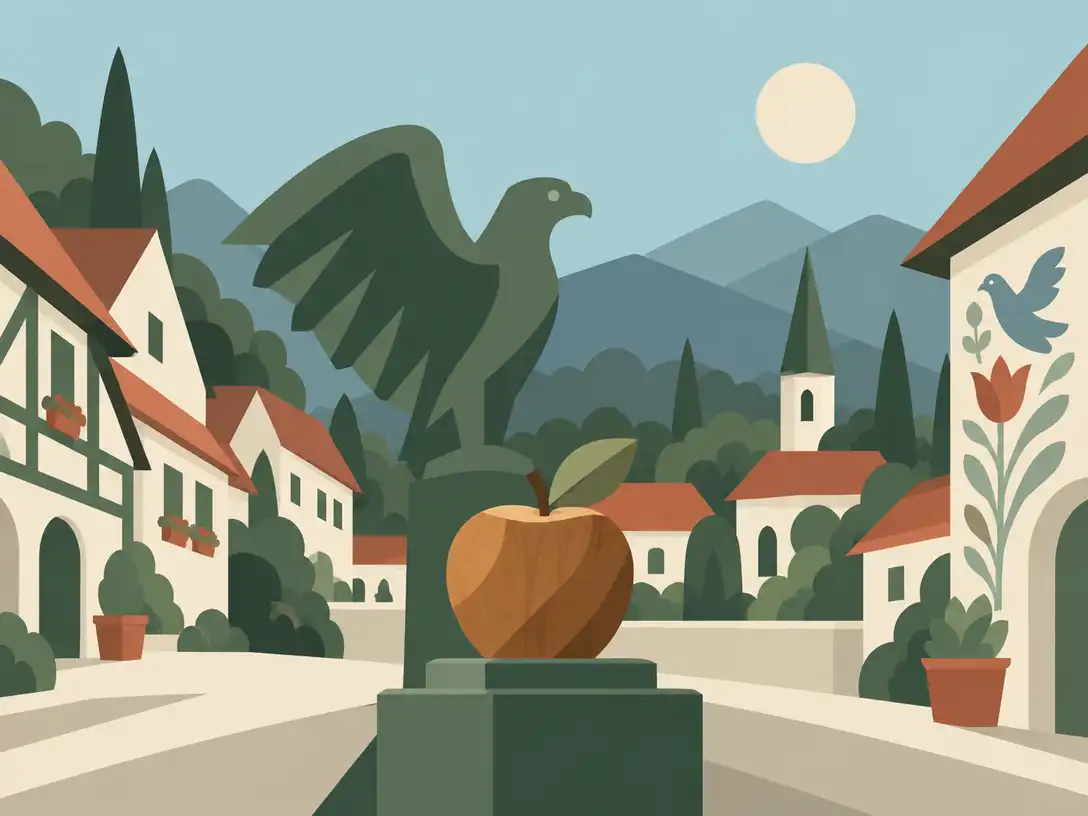
In a small German village lived a particular bunch of people.
If you walked through the village, you could not find an empty wall. Every flat surface was covered with art: paintings on walls, ceilings, and even cars. Statues filled every garden and rooftop. If you came close enough to someone’s window, you could hear songs being sung inside.
The villagers were unusual people. You see, they could not tell the truth.
If you asked them about their lives, they could never tell you how things truly were. But their art spoke louder than words ever could.
Every morning, older folk, while having a cup of coffee, would write a poem and hang it on the front door. If you read it carefully, you could discover their deepest secrets, dreams, and hopes. But they could never say them out loud.
After coming home from school, children would draw paintings so their parents would know how their day had been.
Couples would sing songs to each other to show their affection. But the words “I love you” would never leave their lips in conversation, because that would be the dearest truth—the truth they could not speak.
There was a legend that somewhere in this village a treasure, a so called fruit was hidden.
It was said that if someone were to find it, his eyes would be opened. He would see the hidden truths of the world, things that nobody else could see. He would gain such understanding that even the wisest man alive would seem like an infant in comparison.
And so many pilgrims came through the village.
They would ask the villagers:
“Where is the fruit?”
“Where is it hidden?”
But because the villagers could never speak the truth, none of the pilgrims could get an answer.
Many became hateful and resentful. Their questions could not be answered, no matter how powerful they were or how much money they offered.
And so the villagers came to be hated.
People believed that the villagers knew where the treasure was but simply refused to tell them.
And so it went for decades.
At times, powerful men tried to buy their way to the desired fruit.
Meek and humble men tried to persuade the villagers with carefully chosen words.
Even artists came and tried to make impressive art, hoping to trade it for the truth.
But none were given the answer they desired.
One day, a man came to the village.
He approached it like every other man before him—as hundreds had done over the years.
When he entered the village, his heart dropped.
He was astonished by the art, by the smiling people, and by their way of life.
At first, he did not even ask about the fruit.
He did not speak of it.
As some men before him had done, he found a room, a place to live, and work to do.
During the day, he watched over the sheep.
In the evenings, he would sit in the market and listen to people.
After a while, he became acquainted with some of them. Within a few months, he had even found friends.
And indeed, he lived happily and might have forgotten why he had come there at all.
But as he spent more time with the villagers and saw more of their art, he began trying to create something that could speak as much truth as theirs.
Yet he could never measure up, at least in his own mind.
To him, his paintings seemed to have no colour, and his songs did not seem to dance around the fire the way the villagers’ songs did.
And he became a pitiful man, jealous of everyone around him.
Deep inside he wanted to be a part of this people, one of them.
Then he remembered why he had come there in the first place.
Even though he loved the people, he envied them for their masterpieces.
His deepest desire became to make art the way they did.
So he started asking his friends about the fruit.
But, of course, as with so many people who had come before him, his questions yielded nothing.
Then, one evening after work, he was walking home when he looked at the oldest painting in the village.
It showed two people looking at each other.
Then he noticed something he had never seen before.
The person on the right seemed to be looking just slightly to the side.
He followed the person’s gaze and saw a statue that had also stood there for a very long time.
It was a statue of a dragon.
The dragon’s tail looked suspiciously like an arrow.
So he followed it.
Then he found another clue.
And another.
Eventually, the clues led him to a statue of an eagle.
He looked at it carefully and noticed that the bird held something in its beak, covered with dirt.
He stretched out his arm and pulled at the object, harder and harder.
Eventually, the eagle let it go, and the man fell onto his back.
After wiping away the dirt, he saw that it was a wooden apple.
On the back side of the apple, he found a golden engraving that read:
“Knowledge and understanding are the privilege and reward of the curious—of those who are willing to stop and pay attention.”
He stood there for a long time, holding the wooden apple in his hands. Then he looked back at the village. For the first time, he did not wonder how the villagers made such beautiful things. He simply watched. He noticed the old woman hanging a poem on her door with a slight smile, a boy carrying a painting home from school with his eyebrows scrunched together, and two friends sitting on a bench and playing guitars. And as he walked back through the village, he began to understand that perhaps the secret had never been hidden from him at all.